
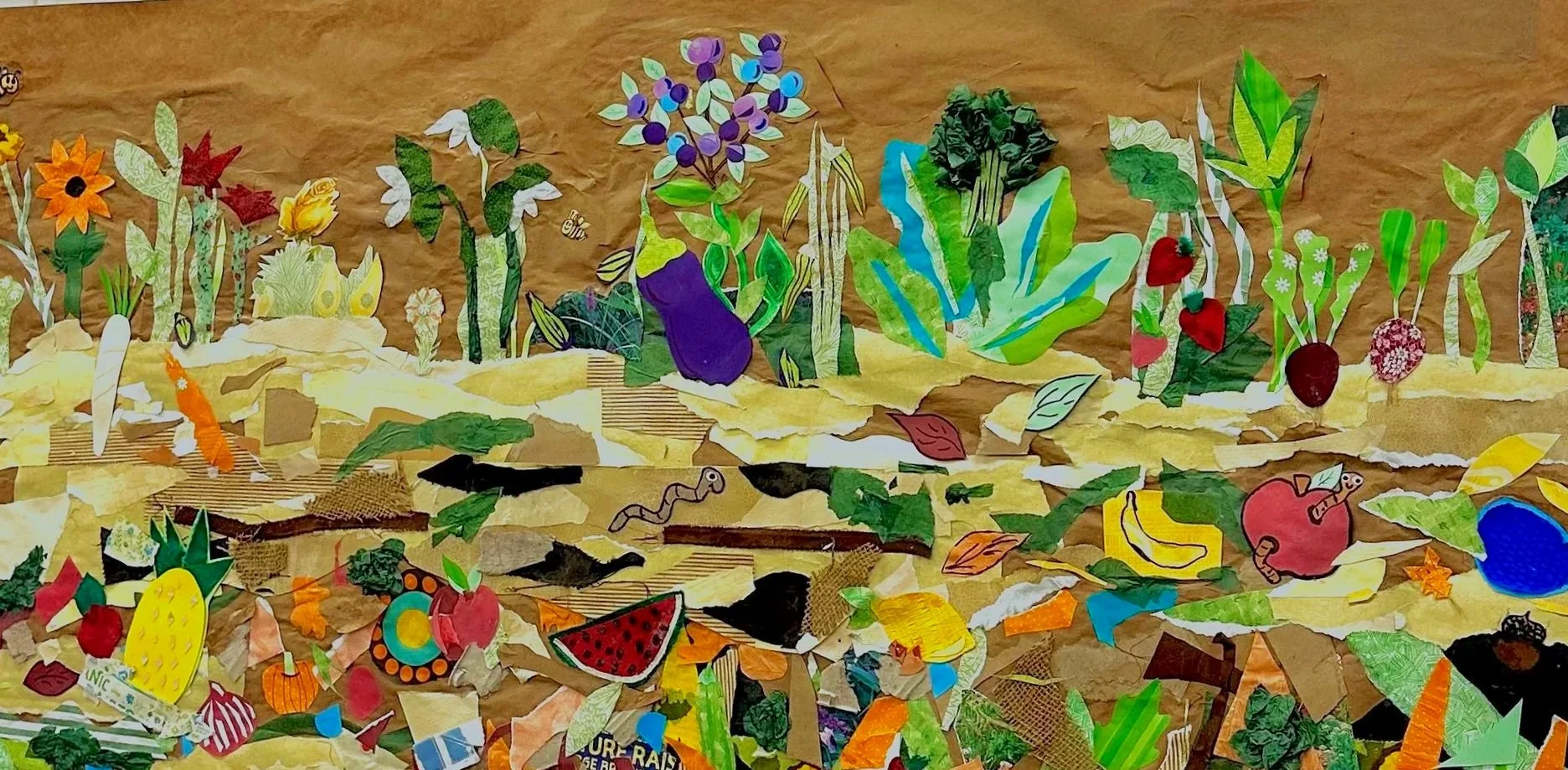
Eco Arts: Food Sustainability
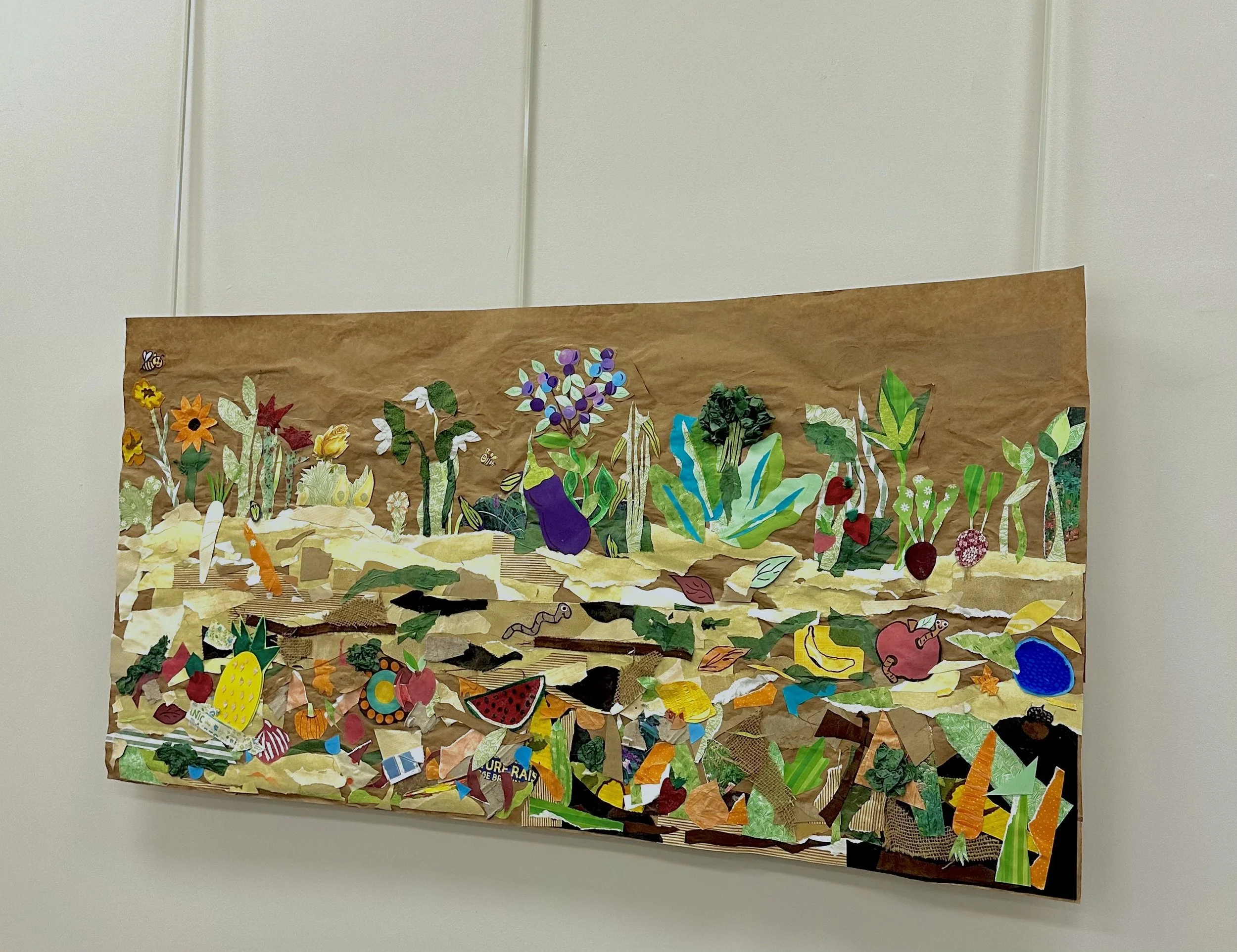
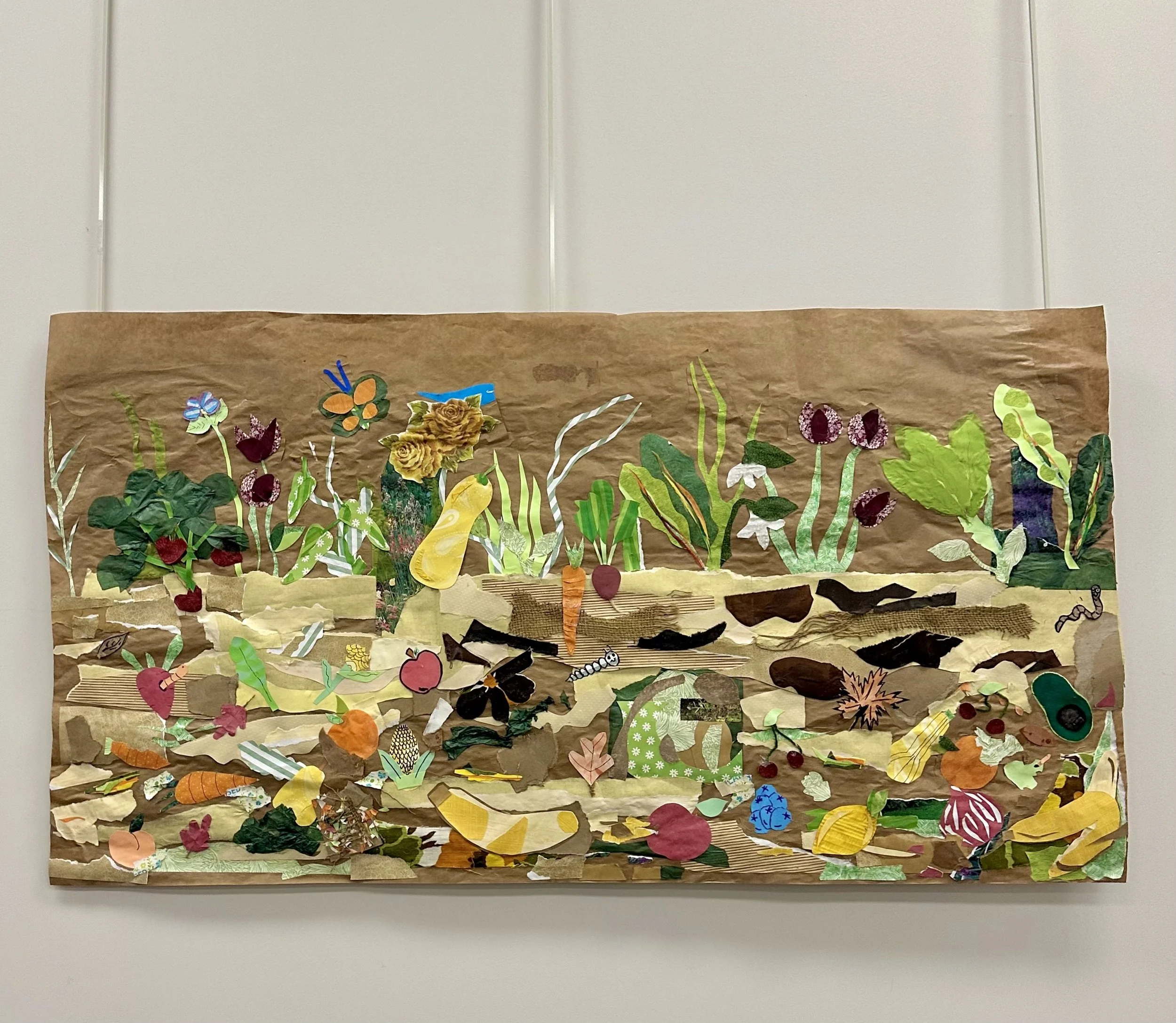
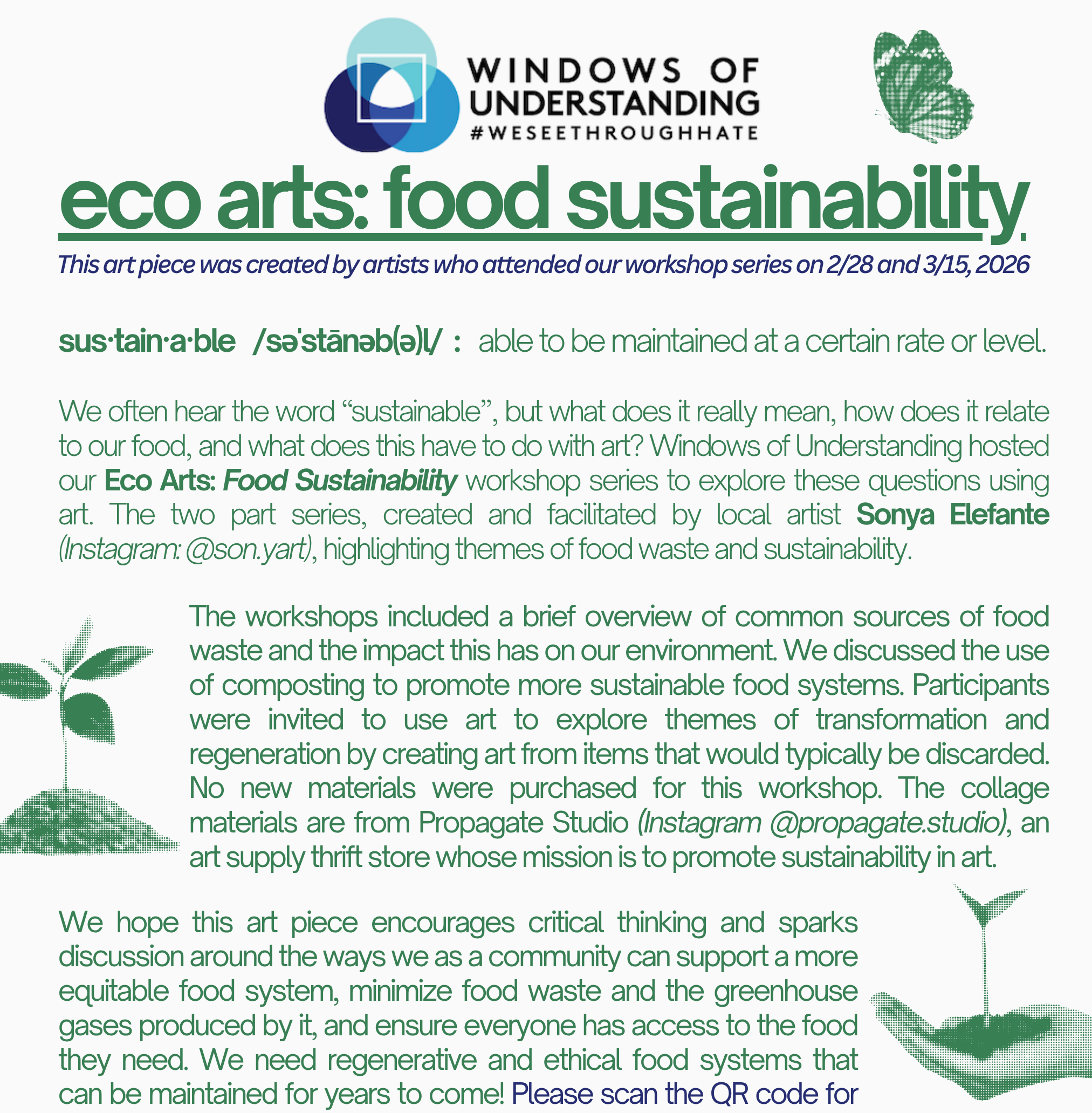
Keep reading for resources that can help us promote sustainable and equitable food systems within our community!
Food waste
An estimated 30-35% of the food supply in the United States ends up as food waste. Food loss occurs across production, supply chain, and consumer food systems. The majority of food waste (roughly 31% of the total food supply) happens at the retail, food service, and household levels. In retail and food service, faulty storage, over-ordering, and disposing of blemished produce results in food loss. Consumers contribute to food loss by buying or cooking more than they need and throwing away the extras. This waste amounts to approximately 133 billion pounds of food worth $161 billion dollars annually (USDA).
This is not just a problem in the US. According to the UNEP Food Waste Index Report (2024) nearly one third of all food produced globally is wasted and disposed of. This includes 20% of food available to consumers in retail, food service, and household spaces and roughly 13% of food lost at the supply chain level and post-harvest, totaling over 1.05 billion tons. (UNEP) The average adult wastes 200-220 lbs of food annually, with households averaging over 350 lbs – that’s several hundred dollars worth of food per year! (Sustainability Matters).
Environmental Impact
This amount of waste has far-reaching impacts. Global food systems as a whole generate an estimated 30% of global greenhouse gas emissions, with food waste accounting for nearly a third of this amount, or about 8% of total emissions.(UNEP, FAO Food Waste Data).
Significant amounts of land, water, labor, and energy are used in producing, processing, transporting, storing, and disposing of discarded food. (USDA)
In the US, food waste is estimated to be responsible for:
· 22% of all freshwater use
· 15% of crop land use
· 24% of landfill inputs
Food scraps that are thrown in the garbage end up in landfills, where they decompose without oxygen and as a result create methane gas in the process. Methane is a greenhouse gas with 80x the warming potential of Carbon Dioxode. Uneaten food in the United States alone is responsible for 170 million metric tons of CO2 equivalent annually. (ReFED).
Food scraps that are properly composted are broken down using oxygen and feed microbes and fungi, eventually transforming into a rich, living soil and that can be used to grow new food.
Social impact
While vast amounts of food are wasted, millions of people struggle to access nourishing meals and clean water. Food that could help feed families in need often ends up in landfills instead. Sustainability is not only about the planet, it’s about the people. The same systems that waste food often devalue the humans who grow and produce it, as well as those who are unable to access it. (USDA, UNEP).
In addition to reducing waste and environmental impact, food sustainability is about:
· Producing food responsibly
· Supporting farmers and farm systems
· Ensuring food access for all
What can I do?
This is a lot of information, and it may feel daunting. But we are sharing this important info because there are things we, as individuals and as a community, can do to help make our food systems more sustainable!
· Plan before you shop so you don’t buy excess
· Freeze unused food before it goes bad
· Cook what you think you’ll eat, and share any extra with friends and neighbors
· Get creative (ie. using ripe veggies to make soup stock)
· Compost! Attend a workshop (see below) or check out details from one of the resources shared (Middlesex County)
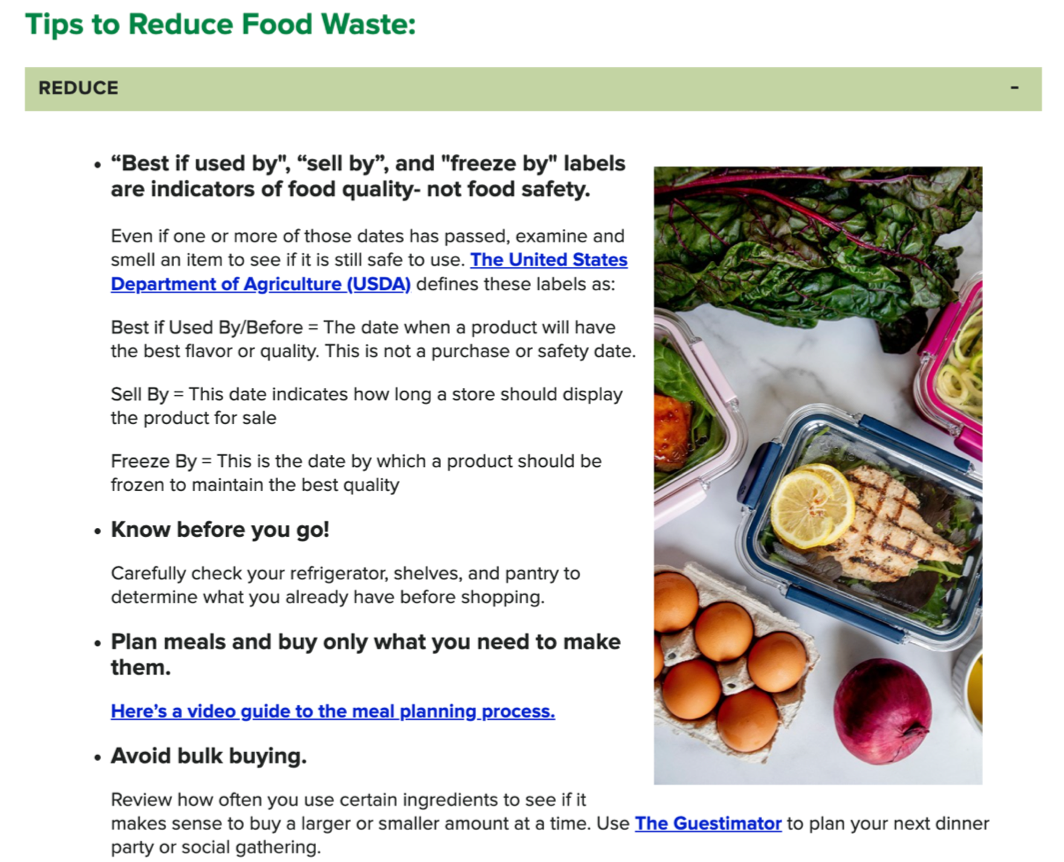
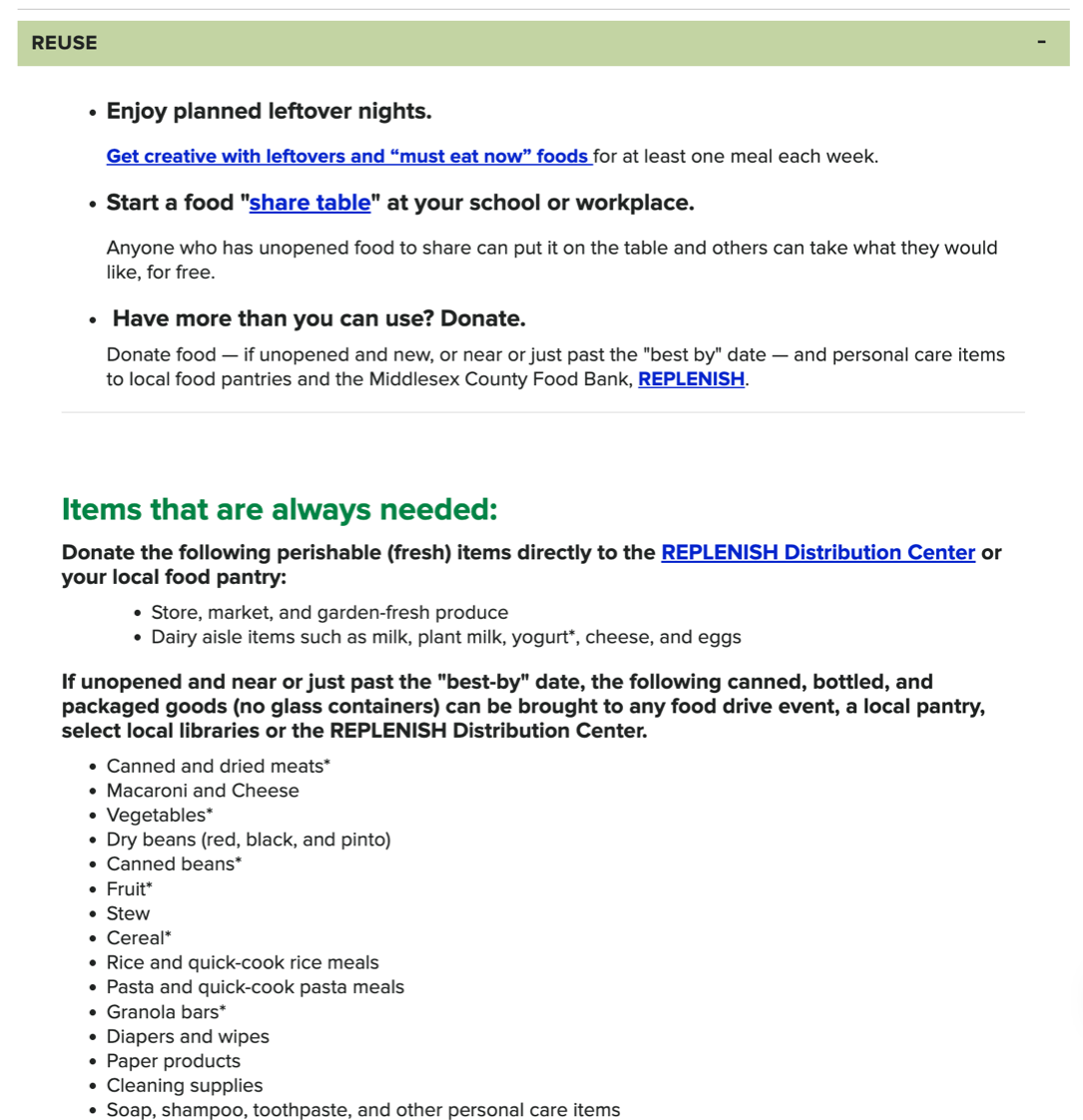
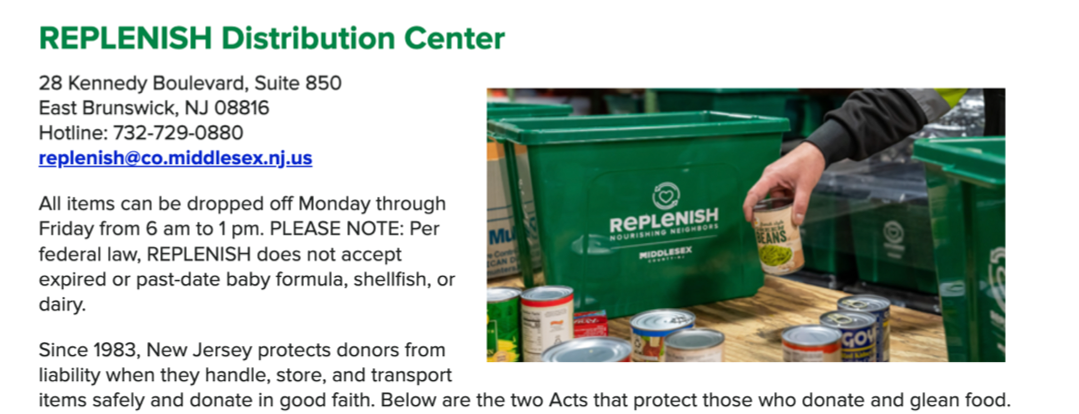
The following Tips to Reduce Food Waste are from Middlesex County solid waste management program and can be found at this link: www.middlesexcountynj.gov/government/departments/department-of-public-safety-and-health/office-of-health-services/solid-waste-management-program/reduce-food-waste
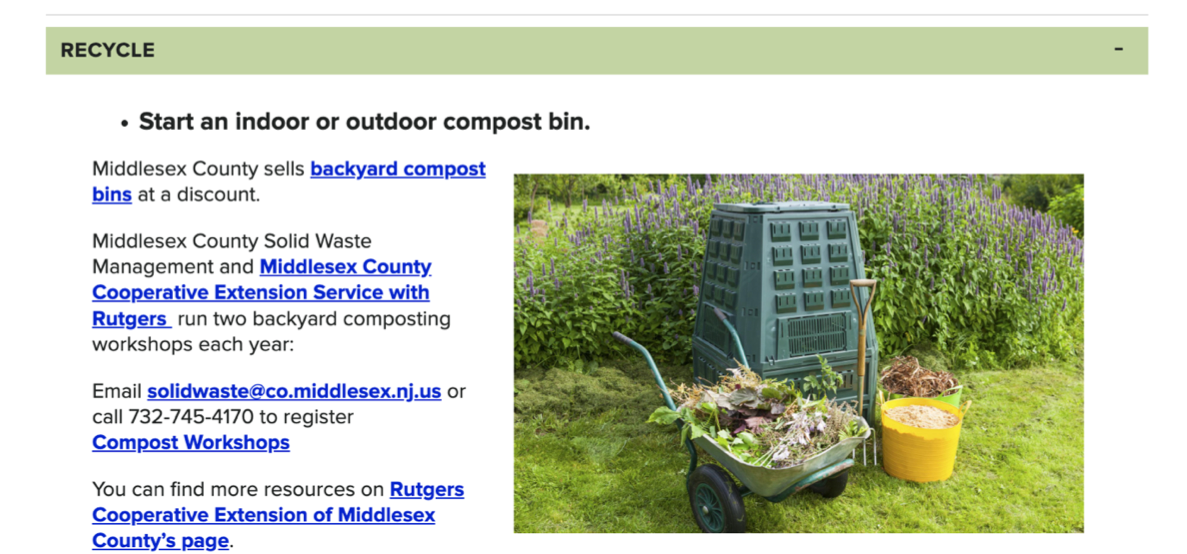
Composting
Composting is the natural process of recycling organic matter (food scraps and yard waste) into a nutrient-rich soil additive. Compost refers to decomposing organic matter that is used to enrich soil. Items that can be composted fall into two categories:
“Browns” (Carbon): Cardboard, egg cartons, newspapers, dead leaves and flowers, untreated wood chips, wood ash
“Greens” (Nitrogen): Vegetable and fruit scraps, egg shells, fresh green leaves, grass clippings, weeds, teabags (biodegradable), some coffee filters
For more information on composting, check out the resources below:
Middlesex County Backyard Composting Workshops (next one is 4/18/2026 10am-12pm)
EARTH Center, 42 Riva Ave, Davidson’s Mill Pond Park, South Brunswick NJ
To register call 732-745-4170 or email solidwaste@co.middlesex.nj.us
Powerpoint from previous workshop:
https://www.middlesexcountynj.gov/home/showpublisheddocument/328/637614531777900000
Highland Park Arts Commission is planning a Learn & Create workshop on composting will be held Saturday May 30th at HPPL. Follow us on social media and stay tuned for more info and specifics!
Rutgers Cooperative Extension of Middlesex County
Additional Resources:
Rutgers Guardians of the Food Galaxy - https://sites.rutgers.edu/gotfg/
ReFED - www.reFED.org
UN Environment Progam (UNEP) Waste Index Report 2024 - https://www.unep.org/resources/publication/food-waste-index-report-2024
Article: Food Waste Breakthrough launches to help cities halve food waste, cut methane emissions and reduce hunger (2025)
Food and Agriculture Organization (FAO) - https://www.fao.org/datalab/filling-data-gaps/food-loss-and-waste-database/en
NJ Department of Environmental Protection (DEP) Division of Solid Waste Management- https://dep.nj.gov/dshw/swpl/fw/
United States Environmental Protection Agency (EPA) - https://www.epa.gov/sustainable-management-food/sustainable-management-food-basics
USDA Food Waste FAQs - https://www.usda.gov/about-food/food-safety/food-loss-and-waste/food-waste-faqs
Sustainability Matters - https://www.sustainabilitymatters.earth/
Yale Sustainability - https://sustainability.yale.edu/explainers/yale-experts-explain-sustainable-food-systems
Let’s Go Compost - https://www.letsgocompost.org/learn
Compost organizations and businesses that provide education, resources and/or home pickup in some areas. Please note that most charge a small pickup fee, and that this is not an extensive list of options, just a small sampling:
· Source Compost (Northern NJ) – www.source-compost.com
· Garden State Composting (South NJ / Cherry Hill area) - https://www.gardenstatecomposting.com/
· Java’s Compost (Essex County) - https://www.javascompost.com/about
· Green Bucket Compost (Union/Hudson/parts of Essex) – www.greenbucketcompost.com